Key points
- After COVID-19's second wave, the technicians running new oxygen equipment needed answers in their own language, on the phones they already had.
- In 2022 we built an intent-based AI chatbot on WhatsApp, in English and 11 Indian languages.
- Every answer was written by experts. The bot did not generate its own answers. It returned prewritten responses. In hindsight, it reflects some of the ideas behind what the World Bank now calls 'small AI'.
In August 2026 the World Bank published its World Development Report 2026: The Promise of Artificial Intelligence. One of its central arguments is that developing countries do not need to build frontier models or giant data centres to benefit from AI. It offers a framework of adopt, adapt and advance, and argues that low-cost tools, which it calls small AI, can put scarce expertise within reach of millions of people through text messages, voice calls and basic phones.
Reading that, I thought of a WhatsApp chatbot we built in 2022 for the people keeping hospital oxygen running. We did not call it small AI, and the World Bank was not writing about it. But looking back, it is a good example of the approach the report describes, and building it taught me much of what I believe about AI in public health.
New oxygen, few experts
COVID-19’s second wave in 2021 exposed how fragile hospital oxygen was in India. In response, an enormous amount of new oxygen infrastructure was installed very quickly. Hospitals received oxygen plants on their premises (PSA plants), liquid oxygen tanks, pipeline systems and large numbers of oxygen concentrators.
Installing the equipment was only one part of the challenge. Keeping it running safely and reliably needed ongoing maintenance, trained people and sound operating routines. Plants need regular maintenance, pipelines need checks, and concentrators fail in predictable ways. Oxygen systems require careful fire-safety precautions because oxygen supports combustion. The people responsible were biomedical engineers, technicians and plant operators, often one or two for many facilities, many of them new to oxygen systems. When something went wrong at night in a district hospital, timely, practical guidance could be hard to get.
At PATH, I provided technical advice on medical oxygen to the governments of Telangana, Andhra Pradesh and Tamil Nadu, across about a hundred secondary and tertiary care facilities. The knowledge existed, in technical guidance, manuals and training material published by WHO, USAID and others. But it existed mostly in English and mostly in documents. The technicians needed it in their pocket, in their own language, at 2 a.m.
Why information, and why in local languages
In development work, information, education and communication (IEC) is not an add-on. It is often the intervention itself. Equipment saves lives only if the people using it know how to run it, and that knowledge has to reach them in a form they can use.
Language was the barrier we kept running into. Many technicians and plant operators were more comfortable in Telugu, Tamil, Odia or Assamese than in English, and the guidance written for them was largely in English. PATH’s own documentation of its oxygen training captured the same need in operators’ words. One plant operator in Odisha asked for trainers who would speak in the local language and show more videos. We wanted to give the information for free, in the languages people actually used, on a channel they already had.
Why WhatsApp
The channel was the easy decision. WhatsApp was already a familiar channel for many of the technicians. It needed no separate app to install, which lowered the barrier to access, although users still needed a connection and some familiarity with how the chatbot worked.
What we built
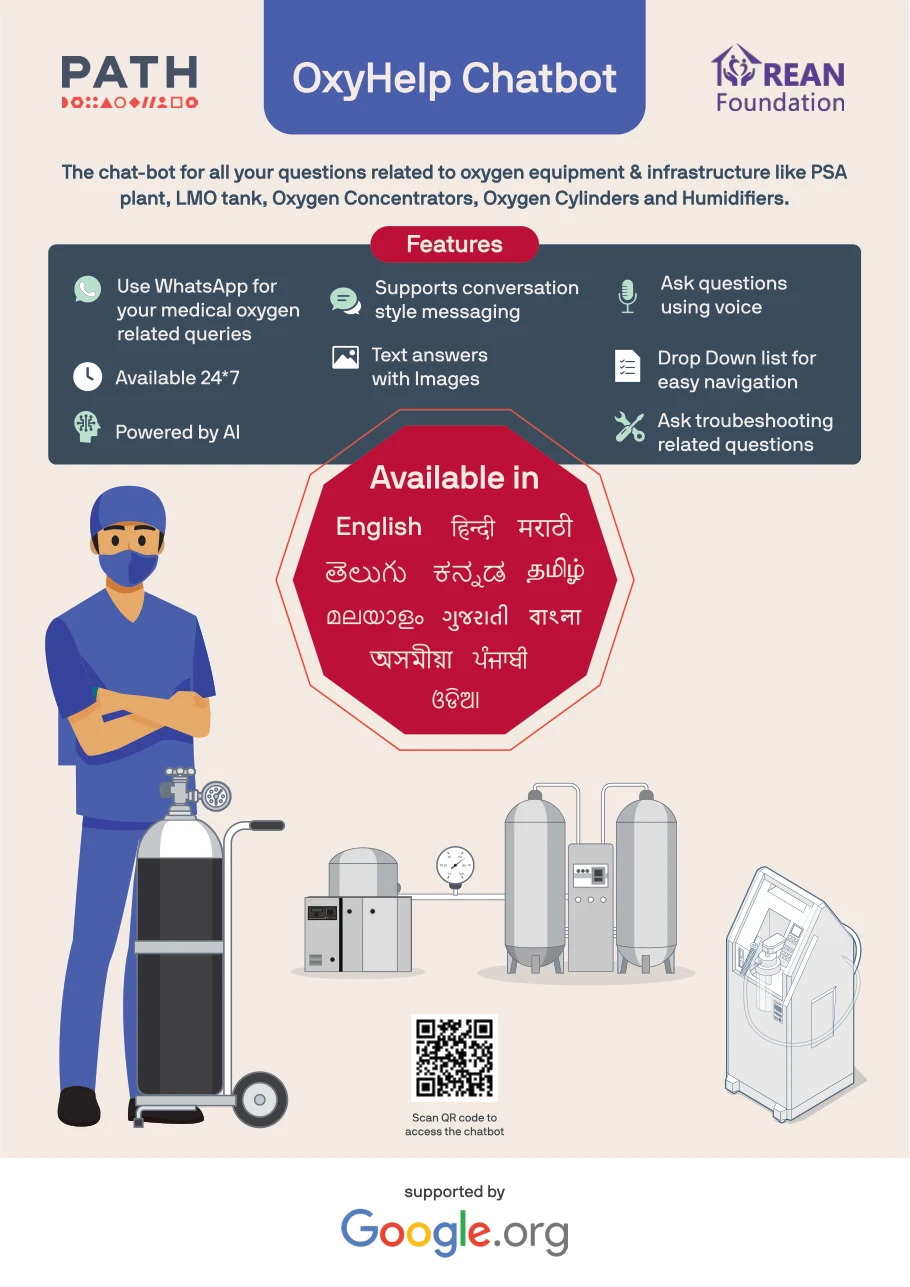
We built the OxyHelp chatbot, a multilingual AI chatbot on WhatsApp, with generous support from REAN Foundation and Google.org. It answered questions about oxygen equipment and infrastructure, from PSA plants and liquid oxygen tanks to concentrators, cylinders and humidifiers. It supported English and 11 Indian languages, namely Hindi, Marathi, Telugu, Kannada, Tamil, Malayalam, Gujarati, Bengali, Assamese, Punjabi and Odia. Users could type or ask questions by voice, get answers with images, browse topics through simple menus and ask for help troubleshooting.
It was built on Google’s Dialogflow, an intent-based conversational platform. There was no large language model and no generated text. The approach was simple, and it had three steps.
- We wrote the answers ourselves, from the technical documents and guidance we already trusted. They covered how to check a PSA plant’s oxygen purity, what a particular alarm means, how to maintain a concentrator and what to do in an emergency.
- We defined the questions people would ask, with many ways of asking each, in each language.
- A machine learning model matched a technician’s question to the closest answer we had written. If it could not find a confident match, it was designed to give a fallback response rather than guess.
It reached more than 500 engineers, technicians and operators. The chatbot was retired in July 2023, as the pandemic response came to a close.
Why “small” was the point
At the time, we might have described these choices as limitations. Looking back, each one was a strength.
- Every answer was written and checked by experts. The bot did not generate its own answers. It returned prewritten responses. In a safety-critical domain, that gave us control over what it said, which mattered more than fluency. It still depended on the content being accurate and on the bot recognising the question correctly.
- It ran on what people already had. WhatsApp, on the phone in their pocket.
- It was light. It required no GPU infrastructure or generative-model inference.
- We controlled the language of the answers, because we prepared the content in each language rather than relying on a generative model whose performance can vary from one language to another. It still depended on good translations and on recognising what the user meant.
- It was designed to admit uncertainty. When the match was weak, it gave a fallback response instead of guessing.
In retrospect, OxyHelp reflects some of the practical ideas in the World Bank’s discussion of small AI, such as adapting available technology to a specific local need, designing around real constraints and making expertise easier to reach.
What it could not do
Small AI has real limits, and we hit them.
- It only knew what we wrote. Every new type of question meant writing a new answer, in every language. Coverage grew slowly.
- Phrasing outside what we anticipated confused it, especially mixed languages, which is how many people actually write.
- It could not reason across documents or help diagnose an unusual combination of faults.
- Keeping it current took effort. When guidance changed, the content had to be updated by hand.
If I built it today
Today I would explore whether a language model could extend what the chatbot did while keeping the safeguards that mattered in the original design. In that design, answers would be drawn only from a curated library of trusted documents, with the source cited. Expert-written answers would be kept word for word for safety-critical questions. Some questions, such as a suspected oxygen leak, would always go straight to a human and a phone number. And the tool would be tested in local languages with real technicians’ questions before launch. Such an approach could still follow the principles of small AI, with a fit-for-purpose model, a curated knowledge base, an accessible channel and a clearly defined use.
Takeaway
Not every problem needs a large AI model. A focused tool built on expert-reviewed content can be an effective alternative when the task is well defined and the tool fits the people using it. OxyHelp was a small example of that.
Views are my own.