
Key points
- Of more than 34,000 models that match health searches on Hugging Face, 348 were downloaded at least 5,000 times in the month to 18 October 2026.
- One open source group, OpenMed, published 261 of them. Among the other 87, the largest groups work on proteins, genes and molecules, and on medical text.
- Medical chat models are a small group. They are all larger than a billion parameters and are more often gated than other health models.
Hugging Face is a website where researchers, companies and individuals share AI models. Anyone can download a model from it, try it and build on it, much as developers share code on GitHub. It has become one of the main places where open AI models are published, and health is no exception.
I wanted a simple picture of what is there for health. Not a test of any model and not a ranking, just a catalogue. What kinds of health models do people actually download, what do they do, how big are they, and on what terms can they be used?
How the models were selected
The search used Hugging Face’s public listing on 18 October 2026. It looked for health words in model names, such as medical, clinical, radiology, pathology, patient, drug, protein and genomic, and added every model tagged medical, biology or chemistry. Compressed copies, add-ons and blends of other models were left out, because they are versions of a model rather than separate models.
That gave more than 34,000 models. Most of them are rarely used. Many are student projects, tests or small experiments, which is a normal part of an open platform. To focus on models that people actually pick up, I kept those downloaded at least 5,000 times in the previous 30 days.
| Health related models on Hugging Face | Number |
|---|---|
| Matching the health searches | 34,065 |
| Downloaded at least 10 times in the month | 12,029 |
| At least 100 times | 1,869 |
| At least 1,000 times | 548 |
| At least 5,000 times | 364 |
| Of these, actually about health | 348 |
The 16 models removed at the last step were general purpose tools that matched a search word, such as search engines, a bird classifier and plant genomics models. Drug discovery and molecular biology models were kept, because they are part of health research.
Each of the 348 models was then marked on a few plain features. These were the area it works on, what goes in, what it does, its licence, whether access is gated, its size and the type of publisher. Every model was counted once, by its main purpose. The full table is available to download, with a link to each model’s page.
One group published most of them
The first thing the table shows is that 261 of the 348 models come from a single source, an open source group called OpenMed. Almost all of them, 260 of 261, are small text tools. Most of them, 187, pick out terms in medical and scientific writing, such as diseases, chemicals, proteins, genes and species. Another 73 find and remove personal details, like names, dates and record numbers, from clinical text, in English, French, Italian, German, Spanish and Portuguese. All of them are released under the Apache 2.0 licence, which allows wide use.
Together they were downloaded about 16 million times in the month. That is a useful reminder that much of the practical work in health AI is unglamorous. Turning free text into structured data and removing personal details before data is shared are everyday needs. Because OpenMed’s models are so numerous and so alike, the rest of this piece looks at the other 87 models on their own, so that one publisher does not drown out everything else.
What the other 87 work on
Biology is the largest single area. Thirty one models work on proteins, genes and cells, and seven more on drugs and molecules. Together that is more than four in ten. A good share of open health AI serves research laboratories rather than hospitals or health programmes.
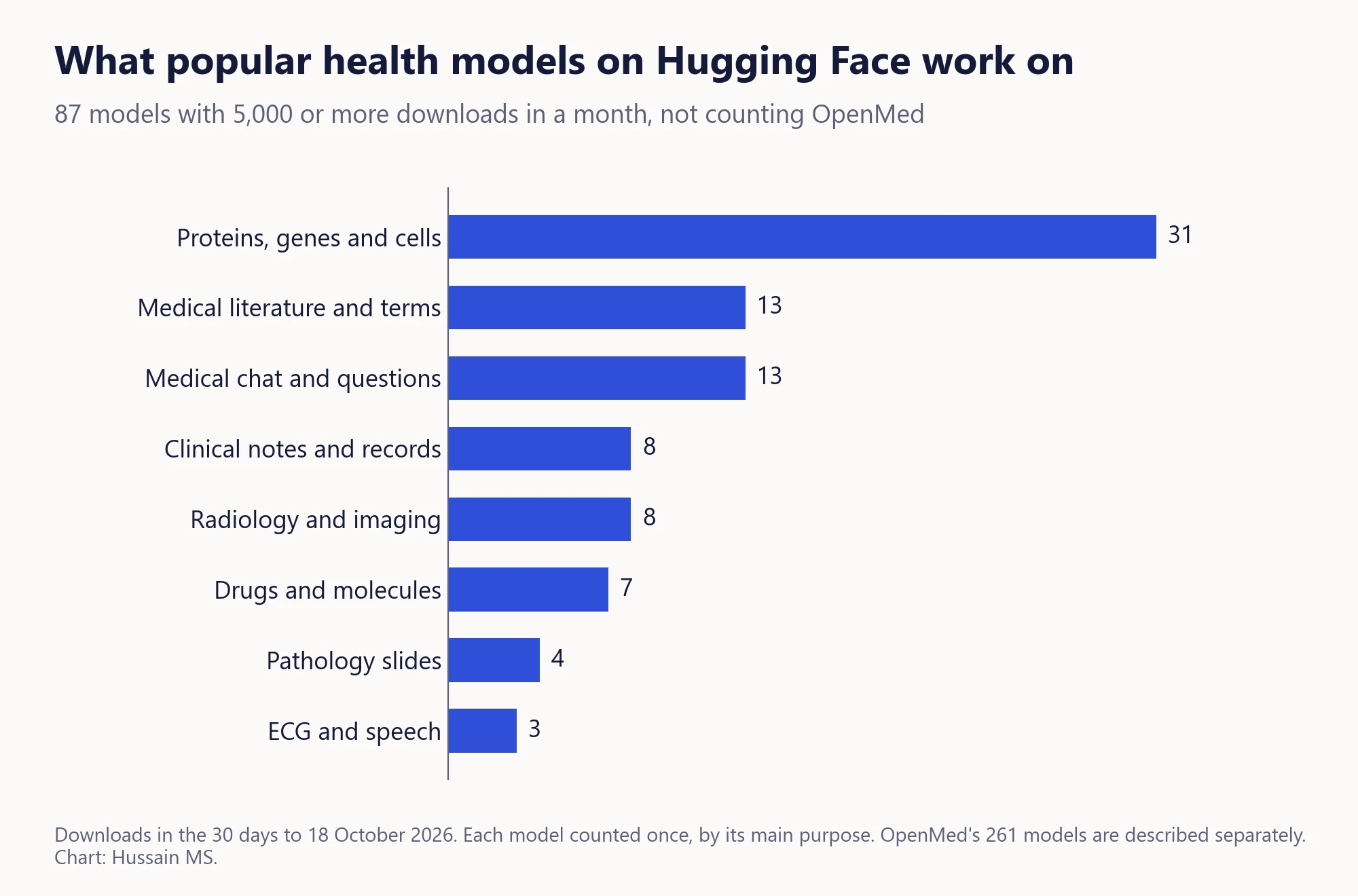 What the 87 popular health models outside OpenMed work on. Chart: Hussain MS.
Medical text comes next. Thirteen models work with medical literature and terminology, and eight with clinical notes and records. The most downloaded model in the whole table is one of these. Bio_ClinicalBERT, published in 2019 and trained on clinical notes, was downloaded more than 2.2 million times in the month.
Thirteen models are medical language and chat models, the kind most people picture when they hear about AI in health. With most of them, you ask a question in plain words, sometimes with an image such as an X-ray, and they write an answer. Google’s MedGemma, BioMistral and LLaVA-Med are examples. Imaging models make up another twelve, covering radiology, ultrasound and pathology slides, and three work with ECGs or speech.
By what they do, the largest group is not chat at all. Thirty nine of the 87 models turn text, images or biological sequences into numbers that a computer can compare, search and match. These are building blocks that other tools are built on.
Most of it is small
Fifty seven of the 87 models, about two in three, have fewer than a billion parameters. Across all 348 models, including OpenMed, the share is higher still, at about four in five.
Size is not the same as readiness, but it does shape what is possible. In principle, smaller models need less computing power, which could make them easier for health institutions, research groups and the organisations that support them to host and adapt for specific tasks. Whether any particular model is suitable would still depend on testing, governance and the people available to run it.
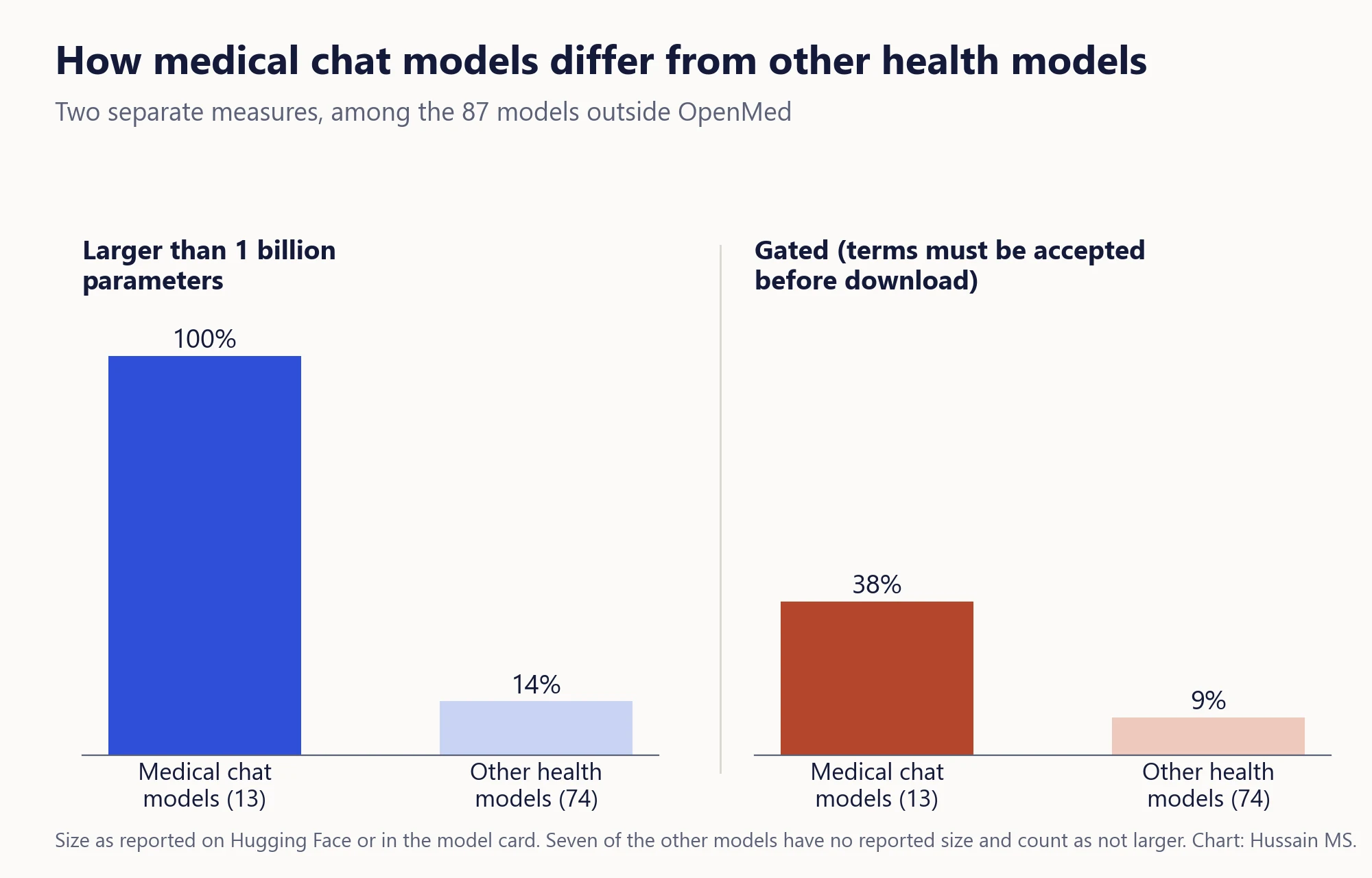 Two separate measures. On the left, how many models in each group are larger than a billion parameters. On the right, how many are gated.
Chat models come with more conditions
The medical chat models are different. All thirteen have more than a billion parameters, and two have more than ten billion. Five of the thirteen are gated, which means a user has to accept terms before downloading, compared with seven of the other 74 models. Four of those five are versions of MedGemma.
Licences vary across the whole table. Of the 87 models, 47 use widely permissive licences such as Apache 2.0 or MIT, 31 use custom or restricted terms, and 9 state no licence at all. These labels describe what is shown on Hugging Face. They are not a legal assessment of what any model can be used for.
What to check before using one
A model being popular on Hugging Face does not mean it is ready for use in a health programme. Before using any of these models, a few practical questions are worth asking.
- Terms of use. Read the licence and any terms behind a gated model, including conditions inherited from the model it was built on.
- Computing needs. Check what hardware the model needs, and whether it can run where the data is.
- Privacy. Using a model on real patient data brings data protection rules into play, and sending data to an outside service may not be acceptable.
- Testing in your own setting. Check how the model performs on your own questions, data and users before relying on it. Scores reported by the developer, or on exam style benchmarks, are a starting point, not proof.
- Upkeep. Find out who maintains the model. Models are updated and replaced, and some are no longer supported after a while.
The data was collected through Hugging Face’s public listing on 18 October 2026, and download counts change every day. Counts were read at listing time, and one model fell just below 5,000 by the time the table was exported. Most columns come straight from Hugging Face. The health area, what each model does and the type of publisher were read from each model card. Views are my own.
Sources
- Hugging Face models, public listing and model cards, 18 October 2026
- Full table of the 348 models (CSV)